

Grokker Innovation Labs just published its 2026-27 Healthcare Benefits Strategy Survey: Financial strategy & ROI, and most of what's in it will feel familiar. As a benefits consultant, you know that your clients are under pressure to prove ROI and get actuarial sign-off from Finance. You're the one translating "tighten the belt" into an actual plan.
What's worth your attention is what the data implies about the gap between what clients are being asked to prove and what most of their current benefits ecosystem can actually deliver. That gap is where your next recommendation can build your credibility and shape a more effective approach to employee healthcare.
Here are the three things worth bringing into your next client conversation. (To keep this post fast-reading and easy to scroll, we’ve included charts for key highlights only. You’ll find additional data and context throughout the text. Download the survey report to access every chart, question, and response.)
1. Clients don't need convincing on ROI — they need a way to prove it
When defending your benefits budget to the CFO, how would you rank the importance of the following ROI data points?
(1 = Most important, 4 = Least important)
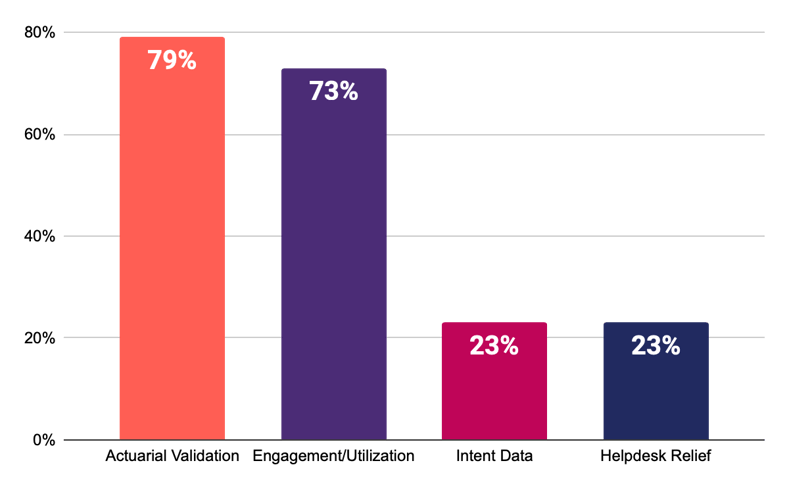
Nobody on your client roster needs to be told that "engagement" isn't enough anymore. While softer metrics still matter, the survey confirms that 62 percent of benefits leaders say proving measurable cost savings is their top ROI priority for the next 12 months. And when it comes to defending the budget to the CFO, 79 percent rank actuarial validation as their top priority.
Another useful data point buried in the findings: Broker and consultant recommendations carry as much weight with employers as vendor-reported data itself — both cited by 71 percent of respondents as a primary input to their decisions. That's opportunity and exposure at the same time. You're being asked to help shape the savings story with actuarial-grade evidence behind it, and most point solutions can't hand you that evidence in a form that survives a CFO's questions.
This is where Grokker changes the conversation you can have.
Instead of asking a client to trust vendor-reported engagement numbers, you can bring data that ties specific interventions to specific cost avoidance. It turns your recommendation from "I believe this works" into "here's the model showing what it's already avoiding in cost," which protects your credibility as much as it protects the client's budget.
HERE'S AN EXAMPLE:
A client with a self-funded plan has a pre-diabetic population they know is out there but can't act on. Today, you might recommend a wellness incentive and hope engagement improves, knowing that "employees who use this tend to do better," exactly the kind of soft claim a CFO has learned to discount.
With Grokker's approach, the same population gets targeted with a 1-3 month diabetes prevention program accessible within Grokker instead of a generic incentive. Six months in, you aren’t reporting "40% of employees engaged" — you’re reporting that 60 of the 200 identified pre-diabetic employees completed the program, and of those, the expected clinical progression rate to Type 2 diabetes dropped enough to avoid an estimated $240,000 in future claims costs, based on the $8,000–$10,000 per-case cost of a diabetes diagnosis.

That's the difference the consultant walks in with: not "the platform is working," but "here's the population we targeted, here's what we prevented, and here's the number Finance can hold us to next renewal." One conversation moves from a belief to a model — and you are the one who brought it.
2. Traditional navigation is breaking down — and employees are the ones absorbing the friction
In response to the rising healthcare cost trend, please rank the following strategic levers in order of their importance to your organization's financial strategy
(1 = Top Priority, 6 = Lowest Priority).
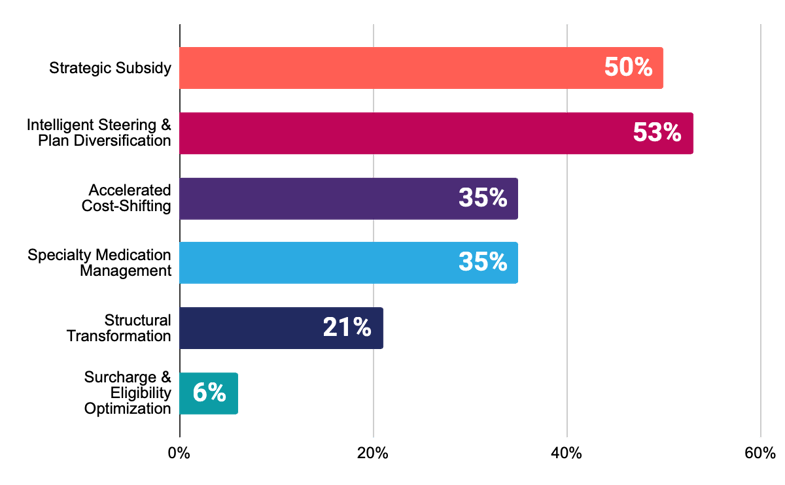
When leaders ranked their top cost-control levers, intelligent steering and plan diversification — guiding employees toward high-value care through smarter plan design — took the top spot at 53 percent, ahead of even shifting more cost onto employees. This suggests your clients would rather change how people navigate their benefits than simply make people pay more for them.
Meanwhile, when we asked what's still unaddressed by existing benefits partners, the same themes surfaced again and again: fragmentation across too many vendors, cynicism about vendor savings reports, and — as one respondent put it, “[a lack of] participant understanding and engagement in the resources that could improve costs [for the] employee and employer.”
The bottom line is an employer can have an amazing plan design, but if their employees can’t easily find their way through it, they won’t know the “right” action to take when it matters most. They might end up defaulting to costlier, higher-acuity care when more cost-effective and clinically appropriate alternatives are available.
This is the case for Grokker's approach to intelligent steering.
Instead of a traditional portal that delivers a series of links to click, Grokky understands the employee's question and context and triages an employee's actual question in the moment and routes them through a tiered pathway — surfacing the lowest-acuity, most appropriate option first, backed by Grokker's expert-led content library, before anything escalates into a costlier intervention.
It's not another vendor to add to the pile; it's the layer that makes the vendors already in place actually findable and usable. That directly answers the "fewer vendors but more transparency" tension your clients are stuck in — because it doesn't ask them to rip anything out.
HERE'S AN EXAMPLE:
A manufacturing employee suddenly needs to fly across the country to care for his father with Parkinson's. Instead of forcing him to hunt through confusing intranet PDFs or call long carrier hotlines during a family crisis, Grokky instantly synthesizes his specific job role, location, and the employer's full benefits stack. The AI immediately delivers a compassionate, step-by-step pathway—explaining exactly how to apply for accrued PTO, outlining his FMLA eligibility, and connecting him to the company's specialized eldercare concierge, while gently clarifying what his insurance does not cover.

By merging the employee's personal context with the employer's unbundled benefits ecosystem, Grokker turns a chaotic logistical nightmare into immediate clarity. It completely eliminates manual HR ticket escalations and ensures employees take the most cost-effective, appropriate actions right when it matters most.
3. The blind spot that keeps HR underfunded — and the fix that closes it
Here's the irony worth naming for clients: HR administrative burden almost never gets funded, and it's not because leaders don't feel it — it's because nobody has the data to put a number on it for the CFO.
- When we asked what leaders are prioritizing to improve ROI, reducing administrative burden on HR came in at zero percent.
- Help desk relief ranked last (23 percent) among the data points used to defend budget to the CFO.
- Even more telling: gaining real-time insight into employee needs also scored zero percent as an ROI priority.
The problem and the proof of the problem are both invisible to Finance, but that doesn't mean the pain isn't real. The survey also asked leaders in an open-text response question to tell us what's actually breaking, and they said:
- “Errors in payroll, billing, and files”
- “[Data doesn’t] land with the right team the first time”
- “[The] amount of time spent connecting information across multiple vendors to get a complete picture”
What’s more, when asked what one interaction they'd most want to automate, the top answer was simple — an intelligent way to handle basic, repetitive benefits questions before they ever reach a human.
So HR is stuck in a loop where their team’s burden is real, but there's no data to justify fixing it because the tool that would generate that data is the same tool nobody's funded yet.
This is the loop Grokker’s Intelligence Suite breaks.
Grokky absorbs the repetitive tier-one questions — eligibility, deductibles, plan basics — with citations back to the client's actual plan documents, so HR stops being the helpdesk and gets time back in their day.
But the more useful part is what that same layer produces along the way: a real-time record of exactly what employees are asking, where they're confused, and where they need a next-best step. That's the evidence HR has never had to make its own case to the CFO, and it's the same underlying intelligence that improves the benefits experience itself, contextualizing each question so employees get guided to the right pathway, not just an answer.
HERE'S AN EXAMPLE
An employee spends a Tuesday afternoon emailing HR asking whether physical therapy for a nagging back injury is covered before they book an appointment. Today, that's a ticket. HR answers it, closes it, and the exchange disappears — no record, no pattern, nothing to point to later.
With Grokky, that same question gets answered instantly, cited straight from the plan document, and the employee gets routed to the right next step — maybe a virtual PT consult instead of an ER visit down the road. But it also gets logged as a data point: HR now sees that "PT coverage" questions spiked 40 percent this quarter, clustered in one department. That's not just a resolved ticket, it's a signal. HR can bring that to the CFO as evidence of exactly where confusion is costing the company money (a plan they're not using efficiently) and where a targeted fix — better upfront communication, a benefits reminder at open enrollment — would pay for itself.

One system, two outcomes: it substantiates HR's own value case while making the benefits ecosystem smarter for the people using it.
The bottom line for your practice
None of this is about telling clients something they don't already believe. It's about giving you a credible way to close the gap between what they're being asked to prove and what their current stack can actually show. The recommendation that wins in this environment is the one that arms you with actuarial-grade evidence for the CFO, doesn't force a client to rip out what they've already invested in, and gives HR real relief in the process — all from the same platform.
If you want to walk a client through the full data set, Download the full Grokker Innovation Labs report here.